
A scheduled wedding, taking place between two alleged gangsters -- Anuradha Choudhary alias 'Madam Minz' from Rajasthan and Sandeep alias Kala Jathedi from Haryana -- is being discussed in police circles.

The biggest bounce is in the realty sector, where the industry index jumped 80%. There's been a turnaround also in automobiles and ancillaries (up 45%). The pharma and health care indices have a welcome return of roughly 35%.
The country's largest private sector lender HDFC Bank on Saturday reported a 23 per cent jump in standalone net profit to Rs 10,055.20 crore for the March quarter, led by growth in loan demand across categories and lower provisioning as bad loans were trimmed. The bank's net profit during the corresponding period of the previous fiscal stood at Rs 8,186.51 crore. "After providing Rs 2,989.5 crore for taxation, the bank earned a net profit of Rs 10,055.20 crore, an increase of 22.8 per cent over the quarter ended March 31, 2021," HDFC Bank said in a regulatory filing.

'We do not see people getting reduced, but because of automation, we will do more work.'

Former RBI governors Urjit Patel and Raghuram Rajan have also expressed worry about the Mudra scheme, particularly government's target-setting practice and the rising bad loans.

In the June quarter of FY24, 51 per cent of consumers who took small-ticket personal loans already had more than four credit products at the time of accessing yet another new loan, compared with just 17 per cent in the June quarter of FY20, points out Tamal Bandyopadhyay.

The country's biggest bank SBI on Friday posted over two-fold jump in standalone net profit at Rs 16,884 crore for the first quarter of the current financial year, helped by decline in bad loans and improvement in interest income. State Bank of India (SBI) had reported a net profit of Rs 6,068 crore in the April-June quarter of 2022-23. The bank's total income increased to Rs 1,08,039 crore in the first quarter of 2023-24, as against Rs 74,989 crore in the same period a year ago, as per the regulatory filing.
Gross bad loans of banks may rise from 6.9 per cent in September 2021 to 8.1-9.5 per cent by September 2022 if the Omicron variant strikes the economy hard, as per the financial stability report of the Reserve Bank released on Wednesday. The report also said that the rising stress level in the retail loan portfolio of banks -- the mainstay of bank credit for many years now -- was led by home loans, which grew in double-digits so far this fiscal. While asset quality improved, with gross non-performing assets (GNPA) and net NPA (NNPA) ratios declining to 6.9 and 2.3 per cent, respectively, in September 2021, the slippage ratio inched up during the same period as private sector banks showed a higher rate of deterioration in asset quality, as per the report.

'Who has given how much money to which party, the people of India must know this fact.'

The governor made it clear that the RBI is aware of what's happening and acts accordingly, but doesn't make a noise about that, points out Tamal Bandyopadhyay.

'For years, the RBI has been warning banks on probable frauds in bank guarantees and advised them to exercise due care.' 'PSB staffers feel their jobs are secured, hence there is no need to be vigilant and exercise financial prudence.'

'We still need a certain number of large public sector banks for financial inclusion and stability purposes.'

State Bank of India, HDFC Bank, Kotak Mahindra Bank, and IDFC Bank have filed a petition against the notice, in a last-ditch attempt by the banking system to keep the information confidential. The notice was given to the lenders under Section 11(1) of the RTI Act, seeking third-party disclosure requirements. While the apex court's original directive in 2015 applied to the full report, it was subsequently agreed that not the entire report but only relevant portions, such as those on bad debts and borrowers, would be made public.

Although such alerts are not compulsory for the banks, this may become the norm now if payments are missed even for a day.
Mergers to create at most six state banks

Banking operations including cheque clearance across the country got affected on Monday as bankers under the aegis of the United Forum of Bank Unions have gone on a nationwide strike to protest against the proposed privatisation of two state-owned lenders.

Despite the objections raised by Reserve Bank of India and Election Commission, India's politics has been funded anonymously and it is time to end this, asserts Aakar Patel.

'Investors need to be stock specific and should not rush to buy stocks at the current levels.'

Central Bank of India's 21.5 per cent assets are either bad or have been restructured.

If Tamil Nadu voters preferred the DMK combine, it owed to the Modi-Annamalai combo's ideological battle which often crossed the line of political decency and also challenged 'Tamil pride', argues N Sathiya Moorthy.

State-owned banks have amassed bad loans faster than private sector lenders.

LVB had faced some serious flak in terms of bad loans, earnings and credit rating downgrades, since 2016.

US hedge fund Tiger Global and Japanese investment giant SoftBank have trimmed their investments in Indian start-ups by over a third - from $3.8 billion in the second half of 2021 to a mere $1.08 billion in H1 2022, according to data from Venture Intelligence. While SoftBank's investments in India dropped from $1.9 billion in H2 2021 by more than a fifth to only $0.33 billion in H1 2022, that of Tiger Global fell from $1.92 to $0.74 billion in the same period. Private equity (PE) fund trackers point out that this year most of the deals that Tiger Global has invested in are in the early stage (up to series D), and only a few are in the series E and above.

Women Of My Billion is stark and disturbing, but at the end of it Srishti Bakshi is still able to say, 'My India is not beyond repair', observes Deepa Gahlot.
The non-watchlist stress emanated from over five year-old loans in the iron and steel, infrastructure and construction sectors.

The central bank is engaged with other financial institutions for investment as part of the scheme to resurrect Yes Bank under RBI imposed moratorium since March 5.

'How can you shoot somebody raising a white flag, even if he's a fighter, when he's surrendered?'

The evolving RBI-government relationship, a reversal in the interest rate cycle and return to profitability will dominate bankers' conversation this year, says Tamal Bandyopadhyay.

What will be its impact on the banks's balance sheets? Since banks need to provide for 10 per cent of the loans restructured, they would need Rs 50,000 crores to Rs 80,000 crore for this purpose, notes Tamal Bandyopadhyay.

False and acrimonious debates such as Modi versus Manmohan might allow for victories that are political and partisan. But the real loser is the nation, India and Bharat, notes Arvind Subramanian, former chief economic advisor to the Modi government in its first term.

While the stress is lower than projections, it would be higher than what we saw last year because of the pandemic: Axis.

Consumer goods firms and auto companies are witnessing an upturn in rural demand, which had been lagging for most of FY24. Expectations of a bumper rabi crop harvest have helped turn the tide. The Reserve Bank of India's (RBI's) Monetary Policy Committee kept the repo rate unchanged last week, noting that as rural demand catches up, consumption is expected to support economic growth in 2024-25.

Guntu Kaaram doesn't deliver on its basic promise: Entertainment, sighs Mayur Sanap.
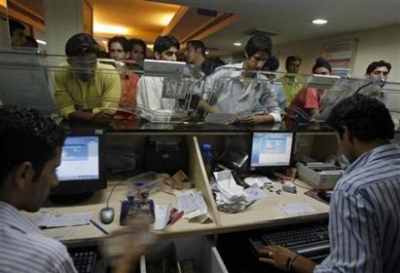
Quarterly results of many of these banks show significant losses.
Amid slowdown blues, the government has unveiled a raft of measures over the past few months aimed at improving liquidity in the system, moderating interest rates as well as credit growth apart from addressing stress in the NBFC sector.

'You will never be able to do any work for society if you wait to make enough money.'

'The policy focus of the government should have been on creating more good quality jobs but that was not their focus.'

After disappointing guidances in the first quarter (Apr-Jun) of the 2023-24 financial year (Q1FY24) and valuation downgrades, the Indian IT sector could see some positive repricing as the bad news for IT maybe easing in Q2FY24. A key negative factor was weaker demand from the US financial sector and from North America in general. The latest GDP (gross domestic product) estimates and sector-specific news suggest that the demand situation may not be quite so bad with a gradual recovery in tech spending in Q2.

'It's a toss-up between a fire sale of equity or merger with a strong bank,' points out Tamal Bandyopadhyay.

The 54-page document tabled in Parliament detailed how the Modi-government pull the economy from being counted among the most fragile-five in the world to being the fasted growing and the most attractive investment destination.
 © 2026 Rediff.com - Advertise with us - Disclaimer - Privacy Policy - Sitemap - Feedback - About us - Terms of use - Grievances